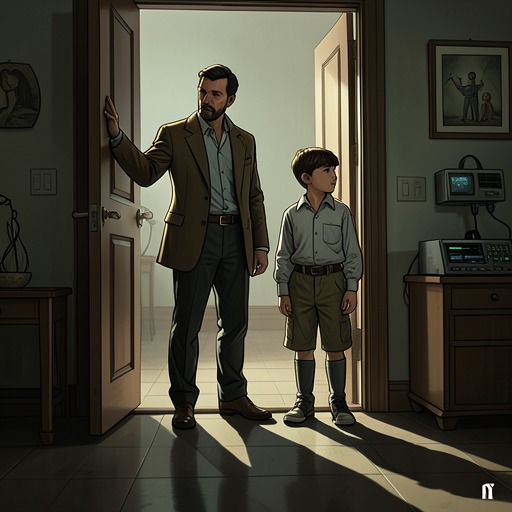
Sean’s first open confrontation with his father
The Greatest Beer Run Ever: A Memoir of Friendship, Loyalty, and WarSean McGahern’s first open confrontation with his father, Francis (Frank) McGahern, turns a familiar pattern of domestic violence into a visible struggle over who can command whom. Sean’s growing strength and refusal to remain afraid break the father’s accustomed authority, even as the two later collude in hiding the violence from others.
Background and Escalating Danger
The confrontation followed a change in the household’s sleeping arrangements. After the maid’s room was cleared, Sean secured it for himself, gaining a place to study and sleep apart from his father. His younger brother moved into Sean’s former place in their father’s bed, a change the father presented as a promotion among the household’s ranks. For Sean, the move also meant greater distance from his father, and he understood that this freedom might hasten an open break between them.
The possibility of violence had already become more than an abstract fear. Sean was growing physically and mentally stronger, and the house had become dangerous for everyone. He knew how to use the .22 rifle and where its ammunition was kept; several times he loaded it in preparation. Nothing happened while it stood loaded in a corner with its safety catch off. The rifle’s presence makes the approaching confrontation feel poised between restraint and catastrophe, though it plays no part in the assault itself.
The Beating and the Reversal
Late one evening, Francis struck Sean hard without warning. Sean understood the blows as part of a violence that did not require a clear provocation: they could arise from irritation or misunderstanding, then leave their cause difficult to identify. He suspected that something sexual might also lie within his father’s violence, but presents this as suspicion rather than certainty. As he fell, he felt an intense unfairness and cold rage.
Sean rose and went straight back toward his father with his hands at his sides, laughing. Francis hit him again; Sean fell several times and each time stood up laughing once more. The laughter did not signal amusement. It accompanied a strange, cold elation and the sense that pain and fear had ceased to govern him. His sisters later told him how terrible it had been to watch him repeatedly get to his feet. The father, who had been the source of the blows, became uncertain and finally broke away.
A Changed Relationship, Kept Secret
The change was understood by both men, but it did not make the beating public. Sean’s face was so swollen and bruised that he could not go out for days. Francis was anxious that nobody should see him in that condition and behaved solicitously toward him. Sean could have left, and believed his father could not have stopped him; instead, they agreed to conceal what had happened. Sean would have had to admit both that his father had beaten him and that he was ashamed to have such a father.
The concealment complicates the apparent victory. Sean has shown that his father can no longer count on fear to end resistance, yet the household still keeps the violence hidden. The scene’s reversal is therefore real but limited: Francis turns away, while the family’s private arrangement remains intact.
The Confrontation’s Aftermath
Some weeks later, Sean found Francis beating one of the girls and shouted at him to stop. Francis turned and struck Sean across the face, leaving finger marks. This time Sean barely felt the blow and warned his father not to do it again, convinced that he could do anything necessary if Francis moved against him. Francis fell back crying and repeated that he had reared a son who would raise a hand against his father. The later exchange shows that the first confrontation was not an isolated release of anger: it had changed the terms of subsequent encounters, and Sean now intervened when his father attacked a sibling.
Francis’s repeated appeal to the authority of fatherhood stands against the evidence of the scene: his son has resisted him, and his daughter’s beating has drawn Sean into the conflict. The first confrontation establishes a new possibility within the household—not safety, but resistance that the father can no longer dismiss as submission.